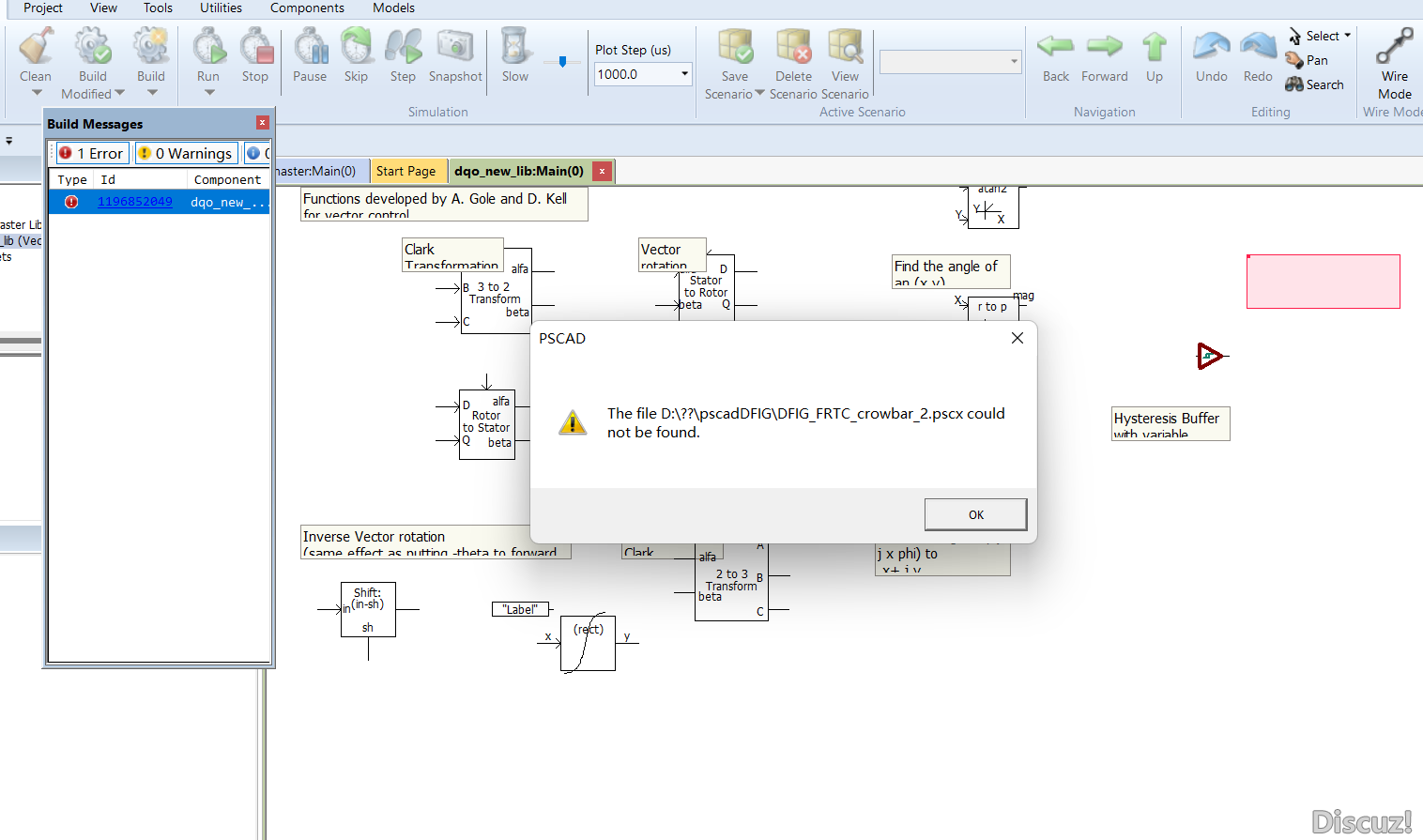
A Newton solution for 3 coupled nonlinear elements has failed to converge within the iteration limit MAXZNO = 50. 8 ^6 ]5 I' n8 uThe current residual is 3.77841495E+02, which exceeds the sloppy convergence tolerance EPSTOP = 1.00000000E-01. The first of : ]/ h+ Q7 f8 U/ z7 Ethe coupled, true, nonlinear elements (in order of data input) is located in row 7 of the nonlinear element table, and it - O4 }( }8 b' [0 @. ?0 K, p" X' vconnects node "X0007C" with node " ". The final coupled element is in row 9, and the matrix rank is 3. Finally, the & W& v8 D# P$ O2 [9 F4 S5 csimulation time is T = 1.08700000E-05. Possible corrective actions include a decrease in the time-step size DELTAT, an increase ( o k; G- O# S! `; M" E- Oin the iteration limit MAXZNO, an increase in the divergence tolerance EPSTOP, and artificial splitting of the subnetwork in( B3 U" r5 ]8 Q1 ~" o8 [ w
question by distributed-parameter lines (to reduce the number of coupled elements). In addition, it is possible for the user to9 \# e" F& E- Z$ o
make a solution impossible by unrealistically limiting the Newton corrections. The user should remember that there can be no 1 i& N, Q4 Q+ A/ X/ u' g* Usolution if his bound on arrester voltage is less than the true solution voltage. The bound has a default value of 1.5 per unit,9 f/ L: ]: l0 f' q* j4 W7 [: d
although it can be changed by a"ZINC OXIDE" special request (columns 57-64, variable ZLIN(2)). Is this parameter involved? The * N' g) ~2 Z4 V6 v Pnumber of solution variables that are being limited this way is 0. If this value is positive, think hard about ZLIN(2).


 赣公网安备36040302000210号 )|网站地图


 狗仔卡
狗仔卡 发表于 2015-4-29 20:50:20
 提升卡
提升卡 置顶卡
置顶卡 沉默卡
沉默卡 喧嚣卡
喧嚣卡 变色卡
变色卡 显身卡
显身卡


