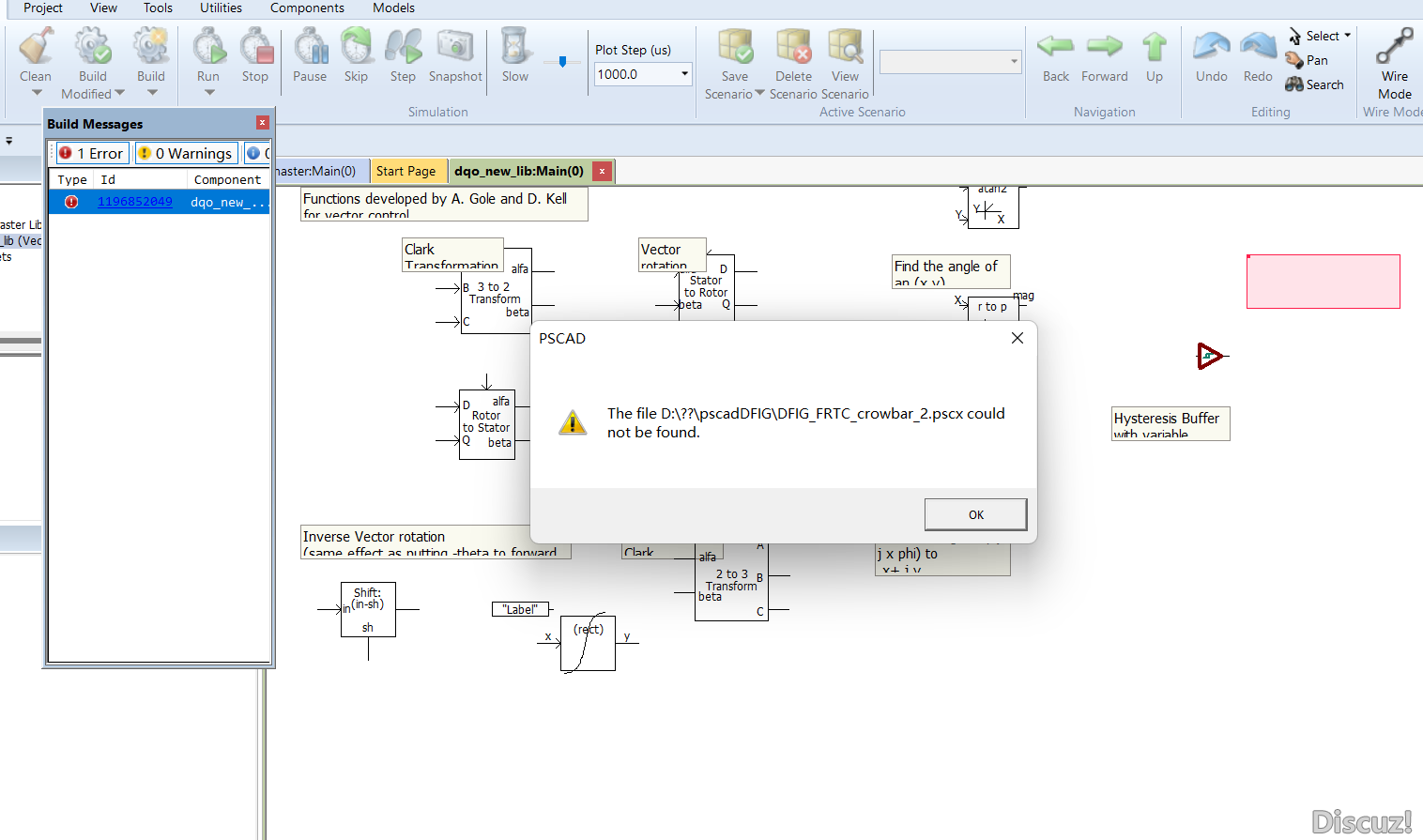
我运行的时候,怎么老是报错呢,其中报错的文件如下:% b% S4 l' ~- ^, }
You lose, fella. The EMTP logic has detected an error condition, and is now going to terminate program execution. The following 3 M6 u! c8 F$ O2 g% G& b6 Vmessage summarizes the circumstances leading to this situation. Where an otherwise-unidentified data card is referred to, or where% U1 V @% k: p4 {2 G D
the "last" card is mentioned, it is the most recently read card of the input data that is meant. The 80-column image of this card " z. W9 a7 ^' v8 Nis generally the last one printed out prior to this termination message. But possibly this last-read card has not yet been 1 c: f, W- C3 |displayed, so a copy follows: : b! h) R' C( H' `5 z, L " LINE1ALINE1BLINE1CTWR4A TWR4B TWR4C TR400ATR400BTR400CPT1A PT1B PT1C " 4 z& {. ^' H9 _/ U0 K) d+ J KILL code number Overlay number Nearby statement number ( A3 |5 W3 Z9 a$ z& k 1 12 1537 7 a" h) Q% z6 m5 u3 E% nKILL = 1. Storage exceeded for EMTP List Number 8. See the dimensioned limit in the case-summary statistics below. The problem' g8 P5 P9 c9 B' N
is simply too big for the program as currently dimensioned. If you are using Salford EMTP for Intel 386- or 486-based PCs, you are ' I9 i! w0 r- Gfortunate enough to have dynamic dimensioning as described in the Oct., 1993, newsletter. In this case, edit LISTSIZE.DAT to! @' D, V2 V' ~6 N
increase table sizes, and then try again. Others need a compiler and linker plus the variable-dimensioning program "VARDIM" in - i9 m- y7 c8 K% Norder to increase EMTP tables before trying again. Sometimes the reason for EMTP table overflow is unclear, however, and Program 3 T% i0 |6 A4 n) }: [" L" L2 ~Maintenance might wish to inspect the contents of the error interface vectors LSTAT and FLSTAT. These now follow. First comes : S: Z6 o4 U9 R0 p2 G9 oLSTAT, using (12I10) encoding; then comes FLSTAT, using (8E15.6) encoding: + r t0 d, G. }3 |( F! O( d% `8 vLSTAT = -9999 -9999 -9999 -9999 -9999 -9999 -9999 -9999 -9999 -9999 11 29. t" w3 Y1 T: E' m( k, _9 L
LSTAT = 255 73 -9999 8 256 3100 1537 -9999 135 149 255 41 G& M( w8 \. K
FLSTAT = 2.810000E-01 2.810000E-01 2.810000E-01 2.810000E-01 0.000000E+00 0.000000E+00 0.000000E+00 0.000000E+00: _; l4 z# |* N/ h, F: F
FLSTAT = 0.000000E+00 0.000000E+00 0.000000E+00 0.000000E+00 5.000000E+01 0.000000E+00 0.000000E+00 0.000000E+00, s% T' b# N' d: M! ?. T
FLSTAT = 0.000000E+00 0.000000E+00 0.000000E+00 0.000000E+00 0.000000E+00 0.000000E+00 0.000000E+00 0.000000E+003 \6 t/ g; f2 e) D+ I( d
Yet maybe the user would like some suggestions as to why the table in question (List Number 8 ) has overflowed. If such further 7 z7 I0 @% V- [; F1 ^7 }information is available, it will now follow immediately .... 4 L! @: ?: \2 d! q' tList 7 stores past history points for distributed-parameter transmission circuits (lines or cables) in modal form. Each$ `" C, }/ I1 g/ n7 j* O1 \- ?
propagation mode requires storage, and there are as many modes as there are coupled conductors or phases (e.g., a double-circuit 0 |& u- n% x! R5 z: Q: {. }) ?8 \line will normally have 6 modes). Each mode requires TAU / DELTAT entries, where TAU is the modal travel time of the line, # g+ |/ X4 Z# ~* D: r8 q' kDELTAT is the time-step size, and the division involves integer truncation followed by the addition of unity. " m h' N! F9 a$ [/ M0 j) eIn order to effectively trade memory space among the different EMTP tables (EMTP List Sizes), the user must know how many arrays - q- i% ^( _3 }( A- `(columns) there are in each table. The following tabulation shows the effective multiplicities that are associated with each " J' Z9 ?& G8 yindependent EMTP List Size (those lists whose lengths are under user control by means of the EMTP variable-dimensioning program ) m9 D7 o1 }8 ?1 Q _"VARDIM").-%-83643-%-



 赣公网安备36040302000210号 )|网站地图


 狗仔卡
狗仔卡 发表于 2007-12-29 15:42:32
 提升卡
提升卡 置顶卡
置顶卡 沉默卡
沉默卡 喧嚣卡
喧嚣卡 变色卡
变色卡 显身卡
显身卡


 发表于 2008-7-13 21:53:28
